A retrospective evaluation of Unitree G1 research configurations: autonomous HANDOFF manipulation and separately controlled, teleoperated stairs. The contributing researcher confirmed the setup and selected outcomes. These observations do not rate the stock product or establish commercial reliability.
We’re preparing three test pools: Basic for minimum expectations, Capability for differences between current systems, and Frontier for long-term challenges. As the field advances, tests can move between pools and the Basic standard will rise through new benchmark versions. These recordings inform test design; they are not scored benchmark runs.
Three excerpts add stair ascent, loss of balance, and hands-on assistance to the evidence archive. They inform candidate mobility tests; they are not scored benchmark runs. Stair difficulty and the test protocol must be defined before assigning a test pool.
Stair ascent observed.
The robot climbs the wide outdoor staircase and reaches the upper landing in this excerpt.
Source: DJI_20250911_153851_26_null_video.mp4, 0:05–0:13. Recorded September 11, 2025 on campus stairs. Unitree G1, teleoperated through velocity/heading commands with a separate locomotion stack. These are distinct attempts, not a controlled comparison with indoor HANDOFF runs.
Balance interrupts progress.
A separate recording shows a loss of balance near the bottom of the stairs, followed by people intervening.
Source: DJI_20250911_154344_28_null_video.mp4, 0:21–0:35. Recorded September 11, 2025 on campus stairs. Unitree G1, teleoperated through velocity/heading commands with a separate locomotion stack. These are distinct attempts, not a controlled comparison with indoor HANDOFF runs.
Human assistance is part of the outcome.
A closer view at a different staircase shows a person making physical contact with the robot during the sequence.
Source: PXL_20250911_194213049.mp4, 5:05–5:20. Recorded September 11, 2025 on campus stairs. Unitree G1, teleoperated through velocity/heading commands with a separate locomotion stack. These are distinct attempts, not a controlled comparison with indoor HANDOFF runs.
Seven new recordings total approximately 24 minutes 29 seconds. Review used timeline sampling and closer inspection of selected sequences, not a complete trial audit. These recordings use different controllers and robot configurations from the May 2026 manipulation footage. No combined success rate is calculated.
The evaluation question
Which stages of object handling are visibly achieved, where does balance break down, and what human assistance is visible?
01 / OBSERVATIONS FROM OUR ARCHIVE
Follow the action. Keep the outcome in view.
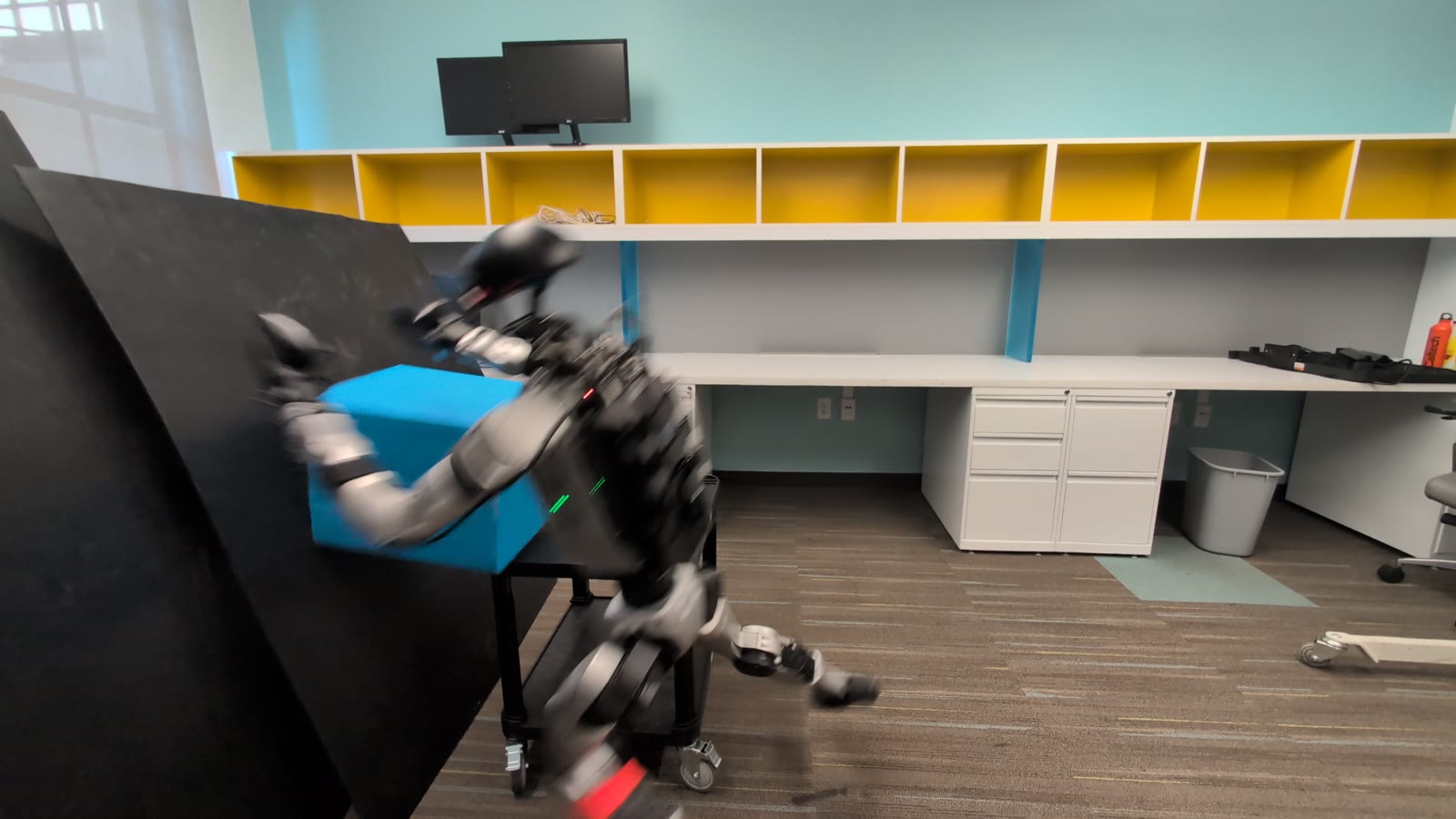
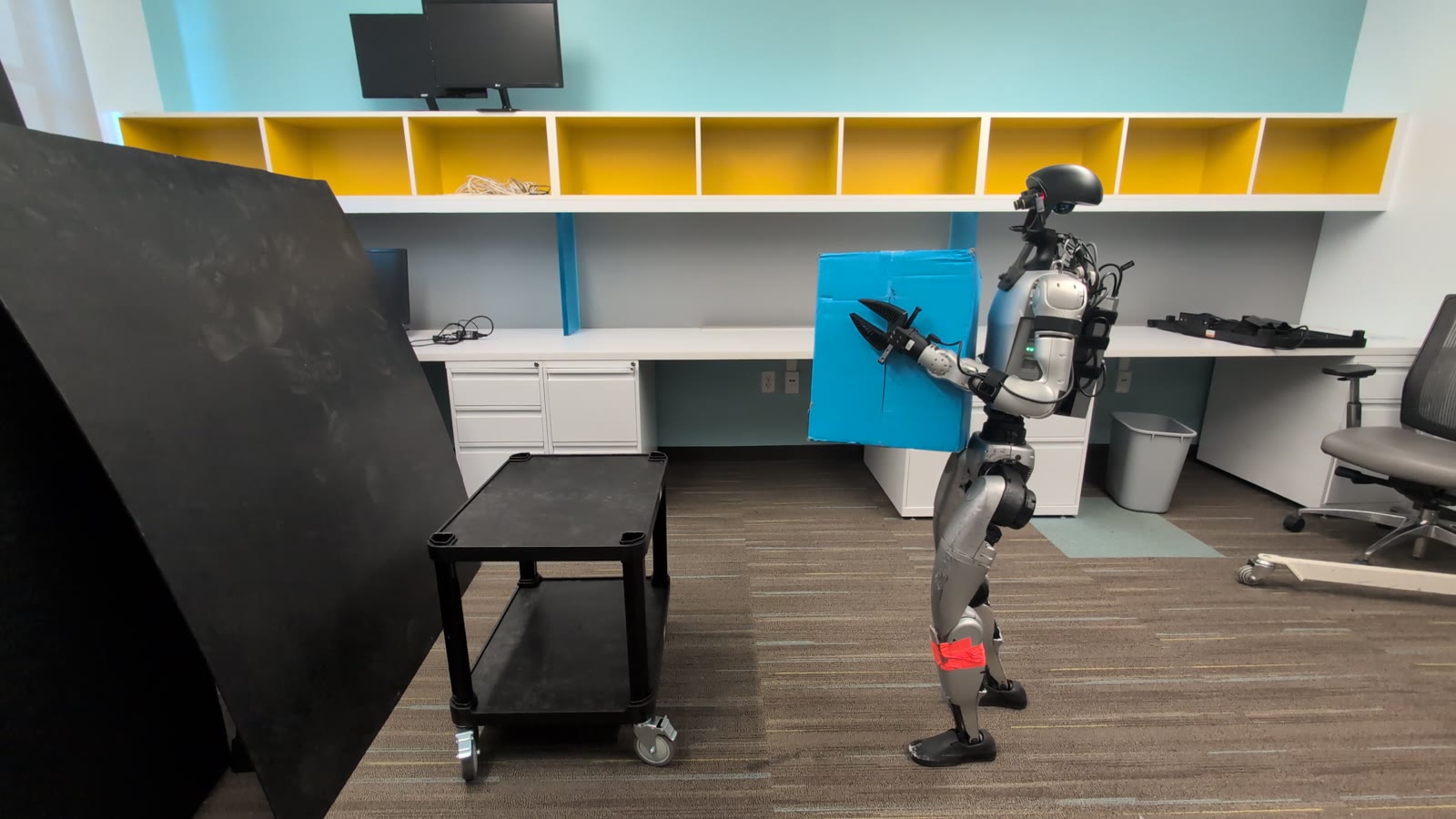
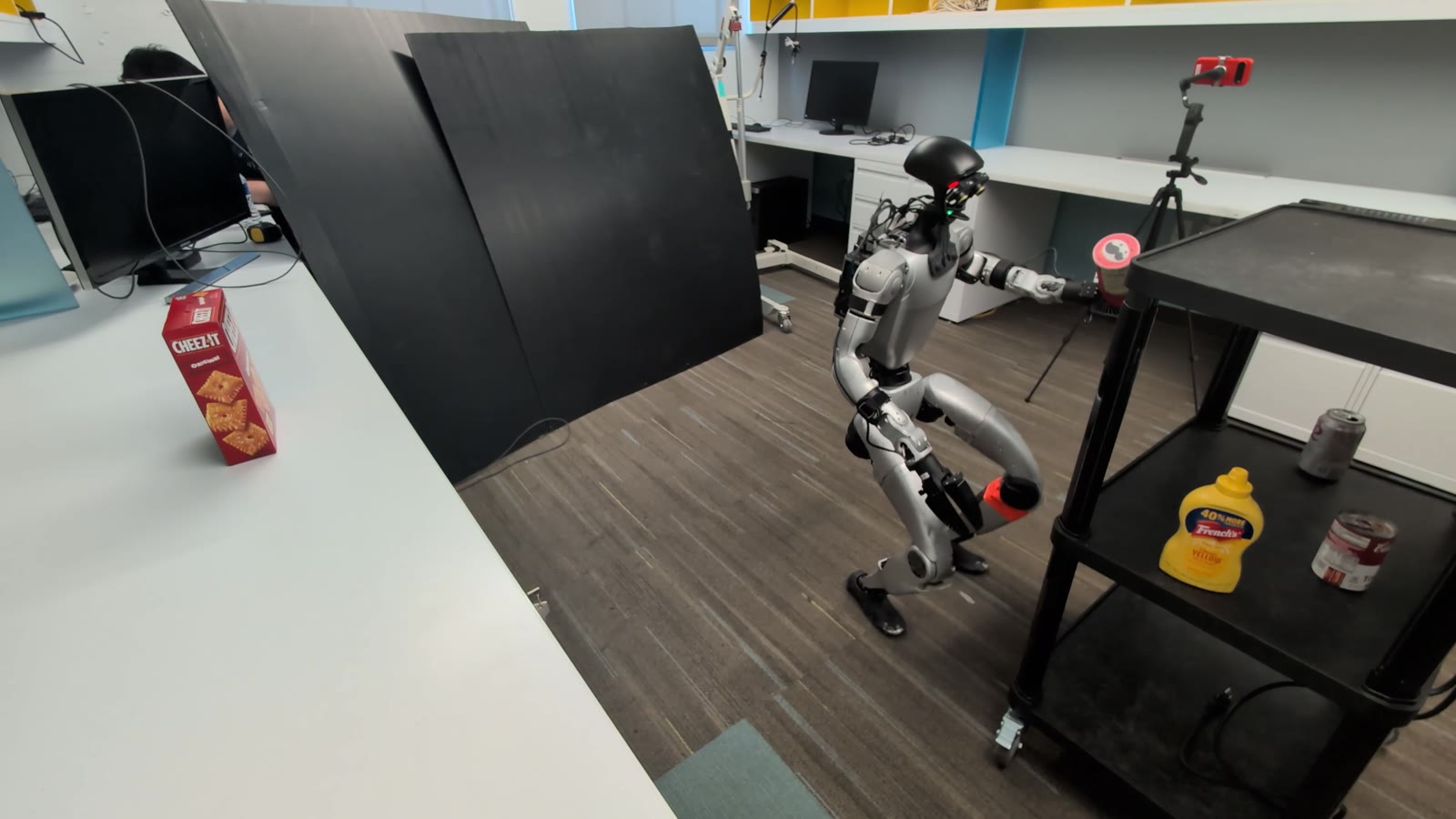
Box attempt A · ~1:10 Loss of balance during lifting; a person intervenes.Watch the evidence ↗︎Box attempt B · ~2:40 A sustained hold is visible. Turning and handover need separate assessment.Watch the evidence ↗︎Shelf sequence · squatexp1 Retrieval, transport, and release are visible.Watch the evidence ↗︎
SHELF SEQUENCE / APPROXIMATE SOURCE TIMES
01Retrieve~1:12
02Rise~1:18
03Transport~1:25–1:40
04Release~1:54–2:03
Observed stages in one recording, not a success-rate measurement. Destination must be assessed against the task instruction; upright placement was not specified.
CASE STUDY 001 / RESEARCHER-CONFIRMED FINDINGS
One system family. Different tasks. Different outcomes.
AUTONOMOUS · HANDOFF
~6 s lift. ≥~15 s hold.
1 kg box. Partial completion: the required turn and handover are not shown.
AUTONOMOUS · HANDOFF
60 s shelf task.
Correct object retrieved, transported and released at the specified destination. Task complete; clean success not verified.
TELEOPERATED · DIFFERENT STACK
4 s stair ascent.
Five steps, 80 cm ascent. Teleoperated completion; clean success not verified.
Six reviewed attempts: 2 task completions, 1 partial completion, 3 failures/interventions; 1 reset. This selected subset mixes tasks and configurations and excludes additional unaudited footage. It is not an overall robot success rate.
Confirmed outcomes, linked to each excerpt. Stage scores describe progress; they are not clean-success ratings. No overall reliability percentage is calculated across different tasks or controllers.
The hands-on stair score is provisional: partial ascent is documented but landing completion is not. ² The completed stair run remains unscored because support evidence is insufficient to distinguish assisted from clean completion. No clean-success designation is assigned to the completed shelf or stair run.
Archive summary: 2 task completions, 1 partial completion, 3 failures/interventions and 1 reset. The two balance-loss incidents were caught, not ground-contact falls. Additional unaudited footage exists; these six attempts are not ten consecutive attempts of one test.
These are retrospective observations of research demonstrations, not prospective trials of the proposed benchmark. The May manipulation and September stair recordings use different configurations.
Robot and sensors
Unitree G1, 29-DoF research configuration; two parallel-jaw grippers; forward RGB/depth camera, IMU, joint encoders and foot-contact sensing. External compute/networking, emergency stop and safety rig.
Manipulation software
HANDOFF: AMP-augmented three-teacher MoE student policy. Checkpoint g1_hand_moe_flat_unicmd_nobv_fullstable_seed_amp, exported from model_20000.pt. A VLM planner uses camera imagery and language instructions; task-space commands drive HANDOFF.
Control and assistance
Indoor runs are autonomous: the operator selects the goal, monitors and can emergency-stop. Stairs are teleoperated through velocity/heading commands using an earlier locomotion stack on the same G1 platform, with a different controller and support setup from indoor HANDOFF. Three interventions: box balance loss, stair balance loss and hands-on stair assistance. The reset belongs to PXL_20260515_001133772.mp4. Both balance-loss incidents were caught, not ground-contact falls.
Support rig
Fall arrest and lateral stability; it does not lift the robot or box. Humans stabilize after balance loss and assist on stairs without completing the task. Support is not established as continuously slack in the completed shelf or stair run; neither is labeled a clean success.
Box instruction and success
“Lift the blue box, turn, and hand it over.” Full completion requires a stable lift, turn and human handover. The public excerpt shows lift/hold only. Lift estimate: approximately 6 s; visible hold estimate: at least approximately 15 s. Frame-exact boundaries have not been established. A separate attempt loses balance at 10 s.
Shelf instruction and success
“Retrieve the Pringles container, turn right, and place it left of the Cheez-It box.” Correct object, destination and release constitute completion; upright placement is not required. Confirmed task duration: 60 s, from first reach to completed release.
Start and time limit
Robot standing near the table/shelf; objects prepositioned. No time limit. Safety spotting and recovery only.
Physical setup
Blue box: 1 kg, 30 × 20 × 15 cm. Pringles: 28 cm tall, 8 cm diameter, 150 g. Cheez-It box: 27 × 20 × 9 cm. Table: 75 cm high. Shelf: 105 cm high. Shelf travel: 2 m. Stairs: 5 steps, 16 cm rise, 30 cm tread, 80 cm total ascent.
Sessions and provenance
Manipulation: May 15, 2026, Caltech/AMBER lab, HANDOFF research demonstrations. Stairs: September 11, 2025, outdoor campus stairs, separate teleoperation stack. Original excerpts play at 1.0× and are trimmed only; each is a distinct attempt, with no duplicates. Additional unaudited footage exists. Full logs and recordings are not published.
Publication and permission
The shelf and blue-box clips match published HANDOFF demonstrations, arXiv:2606.06493v1. The pipeline diagram and Table 2(b) transcription are researcher-confirmed. Paper authors are credited; individual footage recorders are not identified. Site use is authorized by a contributing cofounder; full institutional clearance is not documented. No institutional endorsement is claimed.
Correction: the earlier blanket statement that no hand detached was incorrect. A separate stair attempt, DJI_20250911_155330_29_null_video.mp4 at approximately 00:37, visibly shows a left-hand component separating. This is distinct from the balance-loss attempt in the six-row results table; the exact detached assembly remains unconfirmed.
RESEARCHER-CONFIRMED RULES / PROTOCOL V0.1
Progress and clean success are different measures.
MANIPULATION / 0–3
Task stages
0 No grasp 1 Grasp 2 Lift / transport 3 Correct placement / handover
Score the highest completed stage. Record assistance separately; a stage 3 result is not automatically clean.
Teleoperated and autonomous runs remain separate, even when the same staircase is used.
PASS / ONE TASK AND CONFIGURATION
8 clean out of 10.
At least 8 clean successes in 10 consecutive attempts. Assisted attempts stay in the denominator and count as failures. Recovery assistance does not disqualify the entire batch.
A slack fall-arrest tether is allowed. Lateral stabilization makes an attempt assisted and ineligible for clean success.
Report task completion, clean-success rate, time, intervention rate, reset count, ground-contact falls and caught balance losses separately. There is no invented penalty-weighted index. The present recordings do not establish a ten-attempt pass.
Confirmed timing boundaries
Shelf: first reach to completed release (60 s). Stairs: first upward step to both feet stable on the landing (4 s). Box lift: first task-directed reach to the box fully clearing its supporting surface. Box hold: clearance to first surface contact, handover, drop or clip end. The ~6 s lift and ≥~15 s visible hold are estimates, not verified measurements; clip-end censoring prevents treating the visible hold as a completed hold duration. Source excerpt: approximately 2:28–2:55 in PXL_20260515_001133772.mp4.
Draft procedure for the next test
Freeze one task, robot configuration, checkpoint, objects, environment and allowed control mode before testing. Choose and publish the time limit or stopping rule.
Record ten consecutive attempts, including unsuccessful and assisted attempts. Reset to the same start conditions between attempts; log every restart separately.
Keep continuous video of the task and support rig. Record operator commands, physical assistance, caught losses, ground-contact falls and task-stage completion.
Apply the confirmed rubric to each attempt. Count only documented clean completions toward the 8/10 threshold. Publish the ten rows and evidence before calculating a pass.
This procedure is a proposed implementation of the confirmed rules; it is not a claim that a new test series has been run.
HANDOFF combines planning and whole-body control on a Unitree G1. The researcher confirms that the shelf and box recordings match the published HANDOFF demonstrations and the checkpoint documented above.
GOALTask instruction
→
PLANPerception + planner
→
MOTIONHANDOFF controller
→
HARDWAREUnitree G1
Simplified explanatory diagram adapted from HANDOFF. Our evaluation observes the complete system’s behavior.
Published demonstration · Shelf retrieval
Retrieve the Pringles container and place it left of the Cheez-It box.
Published demonstration · Box handover
Lift the blue box, turn, and hand it over.
Source: HANDOFF project. Author-selected demonstrations; these are supporting research, not additional independently scored trials. Playback timing is as supplied by the authors.
PUBLISHED SIMULATION BENCHMARK / TABLE 2(b)
Controller changes affect feasible reach.
Feasible bilateral wrist-target trials (%) · higher is better
FALCON
35.5%
OpenHomie
62.9%
AMO
80.9%
SONIC
89.8%
HANDOFF
87.1%
HANDOFF + recovery
92.0%
HANDOFF + stability
97.7%
HANDOFF + both
90.8%
Feasible means both wrists within 15 cm, no fall, and pelvis drift below 25 cm. The study uses 2,000 discovery and 400 accuracy targets per controller (seed 42), with adapted interfaces for baselines. These are simulation controller results, not physical task success rates or robot-brand rankings.
The paper describes wrist-orientation and forward-camera limitations. Our next tests should vary grasp orientation and object visibility. Neither limitation establishes the cause of a particular failure in our recordings.
Research credit: Lizhi Yang and coauthors, HANDOFF, arXiv:2606.06493v1 (June 2026 preprint). Reuse authorized by the contributing cofounder. Published results have not been independently reproduced by RoboAnalytica.
Next evaluation
Fix one task and configuration, define success before the test, retain all attempts, document assistance and support, and publish the outcomes with linked source evidence. Where simulation is used, match the controller and conditions and disclose material differences.
 RoboAnalytica